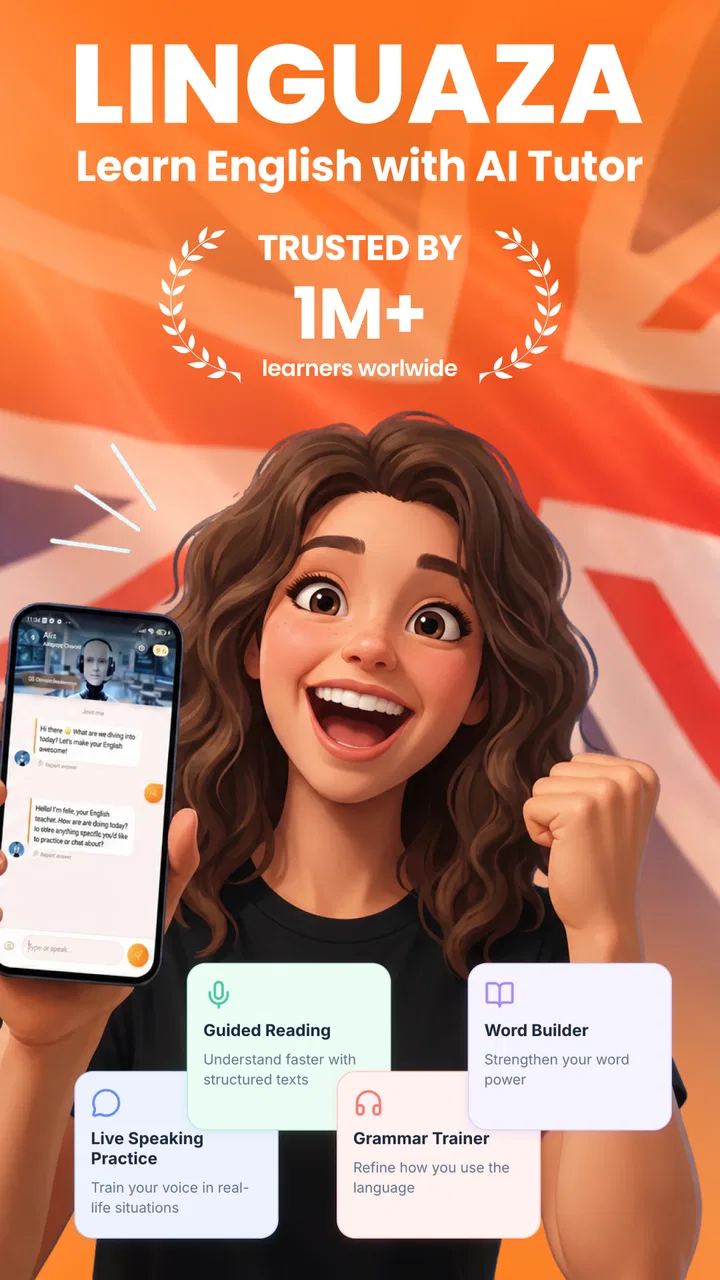
Linguza: AI English Tutor
- 3.9
- Rating
- 5.00M
- Installs
- Free
- Price

 Analysis by App-foxy
I found Linguza: AI English Tutor most interesting as a flexible speaking companion rather than as a complete English course. Its main appeal is simple: I can open it when I have a few spare minutes, practise with an AI tutor, and focus on producing English instead of only reading explanations. That makes it especially useful in a busy household, where one phone or tablet may be used by different people at different times.
The app comes from NXL AI Solutions and sits in the education category. It is free to install, with optional in-app purchases ranging from $6.99 to $89.99 per item. I would not judge it as a replacement for a teacher, a structured school programme, or serious exam preparation. I see it more as a low-friction way to build a speaking habit, test phrases aloud, and become less hesitant in everyday conversations.
Its audience is broad because the content rating is Everyone, but that does not mean every learner will get the same value from it. A beginner may appreciate having a patient practice partner, while an advanced learner may mainly use it to rehearse situations or polish confidence. The important question is not whether it teaches English in the abstract, but whether its AI conversation style fits the way you actually study.
You May Also Like

 Blood Strike: 2.5 Anniversary
Blood Strike’s Loadouts Turn Every Drop Into a Tactical Gamble
A close look at Blood Strike’s custom loadouts: how fast access to signature weapons reshapes its battle royale rhythm, rewards preparation, and narrows the gap between fights.

 Pandora - Music & Podcasts
Pandora’s Music Is Easy to Start, but Harder to Recover
Pandora’s strength is its low-effort path from a seed to a station. Its weak spot is how much confidence it asks you to place in connection, setup, and quiet recovery.

 8 Ball Pool
 Is Built on Rivalries, Rematches, and Routine
A close look at the rivalries, rematches, shared routines, and unanswered safety questions that turn a quick pool match into a persistent mobile community.

 Samsung Music
’s Quiet Strength Is Playing What You Already Own
Its reach comes less from spectacle than from dependable access to a personal library. That simplicity is both the app’s strongest retention engine and its ceiling.

 AccuWeather: Weather Radar
AccuWeather Review: A Quick, Clear Forecast for Everyday Decisions
For everyday plans, the best forecast is the one you can understand quickly. AccuWeather makes rain timing, radar, and local conditions easy to act on, with a few trade-offs.

 Hill Climb Racing
Why Hill Climb Racing Still Turns Crashes Into One More Run
A tiny car, a bumpy hill and one more upgrade: Hill Climb Racing keeps resurfacing because its simple chaos makes every near-miss feel personal.
More From Our News Desk



How Linguza fits into a shared household routine
I’d make Linguza part of a shared household routine by giving each person a distinct practice goal and a quiet turn, rather than passing one open conversation around. That keeps a short session focused and makes it easier to tell whether the app is helping each learner. From there, the next useful question is how to keep practice going without letting it become another chore.
A realistic shared-device scenario
Imagine a family tablet resting in the kitchen. One person uses it before work to practise introducing themselves in English. Later, a teenager opens it to rehearse travel phrases, and in the evening another family member wants a short speaking session before an online meeting. That is the kind of setting where an always-available tutor can be convenient. Nobody needs to arrange a lesson or wait for another person to become available.
In my experience, the strongest use of an app like this is not a long study session. It is the small moment that would otherwise disappear: ten minutes while coffee is brewing, a quick rehearsal before a call, or a few spoken answers during a quiet commute. Those short sessions can help turn passive knowledge into something I am willing to say aloud.
However, a shared device also changes the way I would use it. I would not assume that one person’s progress, preferences, or conversation history should automatically serve everyone else. Each household member needs to know whose session is active, and anyone using the app should avoid treating a family tablet as a private diary. That is not a criticism of the tutor itself; it is a practical boundary whenever several people use the same screen.
For a parent, the best arrangement is to agree on simple routines rather than pretend the app replaces supervision. A child can practise basic phrases while an adult remains nearby, and an older learner can use it independently for repetition. The app’s Everyone age classification makes it approachable for a mixed-age home, but the learning goal still needs to be appropriate for the individual using it.
What the first session is really for
I would begin with a narrow purpose instead of trying to improve everything at once. For example, I might choose introductions, ordering food, asking for directions, or answering common work questions. A narrow target gives the conversation a useful shape and makes it easier to notice whether I am improving. Without that focus, an AI tutor can become an interesting chat that feels educational without producing a clear next step.
One useful habit is to speak in complete answers even when a shorter reply would be accepted. If I am practising a job interview, saying only a keyword does not prepare me for the pressure of forming a full sentence. I would also repeat an answer in a second version rather than immediately moving on. The first attempt reveals what I can produce spontaneously; the second shows whether I can correct and strengthen it.
Another practical technique is to keep a small list of phrases that caused hesitation. I would write down the phrase after the session, then return to it later and use it in a new sentence. This turns an informal conversation into a personal revision loop. It is more effective than simply collecting unfamiliar vocabulary because the phrases are connected to a situation I actually tried to describe.
Setting boundaries before several people use it
On a shared phone, I would establish a simple handover rule: finish the current practice, close the session, and tell the next person that the device is available. If several people speak into the same microphone without resetting the conversation, the tutor may receive confusing context. Even when the app handles the exchange smoothly, the learner can lose track of whose objective is being practised.
I would also separate learning roles. A parent might use the app for pronunciation confidence, while a child uses it for basic conversation. They should not be measured against one another or expected to follow the same prompts. A quieter learner may need more time to formulate an answer, whereas an experienced speaker may benefit from more demanding scenarios. Shared access works best when the household shares the device, not necessarily the same study plan.
Because Linguza is free to start, it is easy to let several people try it before deciding whether it deserves a regular place in the routine. That is sensible, especially when the optional purchases are substantial at the upper end. I would test whether the free experience supports the family’s actual needs before paying for anything. The right question is not whether premium access sounds useful, but whether someone is using the tutor consistently enough to justify the expense.
Coordinating practice without turning it into homework
Coordination matters more than many people expect. If a household says “use the app more,” that usually produces vague intentions. A better plan is to assign each person a small, visible goal: one person practises speaking about work, another focuses on travel, and another reviews everyday requests. This avoids duplicated effort and gives everyone a reason to open the app.
I would keep the schedule light. A short session several times a week is more realistic than demanding a long lesson every day. The app’s anytime format supports this kind of flexible rhythm, but flexibility can also become an excuse to postpone practice. A reminder on the family calendar or a fixed moment after dinner may be enough to make use more consistent, without treating the tutor like a strict classroom.
For couples or roommates, the app can be useful for rehearsal before a shared event. One person might practise explaining a hotel problem, while the other prepares questions for a host or colleague. They can then compare which phrases felt natural. This is a more concrete use than simply chatting for entertainment, and it exposes gaps that vocabulary flashcards often leave hidden.
There is also a trade-off in practising together. A confident speaker may dominate the exchange and unintentionally answer for a beginner. I would give each person separate turns, even if the same device is used. The goal is to make the less confident learner produce language independently, not to let the strongest speaker create a smoother conversation for everyone.
Age, trust, and the limits of an AI tutor
The Everyone rating makes Linguza suitable for a broad audience, but I would still treat it as a tool that needs context. Younger users may accept an AI response too readily, especially when they are unsure whether a sentence is correct. An adult should encourage them to question unusual wording and compare important schoolwork with a teacher, textbook, or trusted reference.
This matters because language has nuance. A sentence can be grammatically understandable and still sound too formal, too direct, or unnatural in a particular culture. I would use the tutor to generate speaking practice, then ask a human teacher for guidance when accuracy, tone, or assessment matters. That is particularly important for applications, formal emails, medical situations, and other high-stakes communication.
I also would not use an AI conversation as a substitute for a child’s wider online safety education. The app can support English practice, but it should not be treated as a private friend or an authority on personal decisions. The most sensible household rule is straightforward: use it for language, avoid sharing unnecessary personal details, and involve an adult when a topic becomes sensitive or confusing.
For adults, trust has a different angle. Some learners may feel embarrassed speaking English in front of relatives, even when the AI itself feels non-judgmental. A private moment with headphones can make practice easier, but on a shared device I would still respect the person’s space. Nobody should be forced to display mistakes to the rest of the household. Confidence grows faster when errors are treated as normal practice rather than entertainment.
Where it beats familiar alternatives
Compared with a traditional vocabulary app, Linguza is better suited to learners who know many words but freeze when they need to build a sentence. Flashcards are excellent for recall, yet they rarely reproduce the pressure of responding in real time. An AI tutor can make the learner retrieve language actively, which is closer to what happens in a conversation.
Compared with a live tutor, the obvious advantage is availability. I can practise without arranging a lesson, and I do not have to spend a full appointment on a small question. That makes the app a useful supplement between classes. The disadvantage is equally clear: a human teacher can notice hesitation, explain cultural context, adapt a lesson with richer judgement, and recognise when a learner has misunderstood the underlying rule.
Compared with language-exchange services, the experience may feel less socially demanding. That is helpful for someone who is nervous or does not yet have enough confidence to speak with strangers. On the other hand, a real exchange partner provides unpredictable accents, interruptions, humour, and genuine social consequences. Linguza can help prepare for those moments, but it cannot fully reproduce them.
Compared with a conventional course, the app is more flexible but less reassuring for learners who need a clear sequence. A textbook or guided programme tells me what to study next and how concepts connect. Here, I would need to supply some of that structure myself. Learners who dislike planning may enjoy the freedom at first and then feel that their progress is scattered.
Practical ways to get more from each conversation
I would use a three-stage routine. First, speak without preparing a perfect answer. Second, notice one problem, such as missing vocabulary or an awkward sentence. Third, repeat the idea with a small improvement. This keeps the session active and creates a measurable learning action without requiring a formal notebook or lengthy lesson.
A second technique is to vary the same topic across different audiences. I might explain a weekend plan casually to a friend, then describe it more formally to a colleague. This reveals whether I know only one memorised version of a phrase. It also helps with register, an area where many learners struggle even after studying grammar for years.
I would avoid using the tutor only for translation. Translating every thought from my first language can make speaking slow and dependent on exact equivalents. Instead, I would describe an object or idea with simpler English when the precise word is missing. That workaround is a real communication skill, and an AI practice partner is a convenient place to develop it without the embarrassment of stopping a live conversation.
Finally, I would judge progress by behaviour rather than by the number of sessions. Am I answering faster? Can I explain the same idea in two ways? Do I recover when I forget a word? Those signs matter more than simply opening the app. Linguza is most valuable when it changes what I do in English outside the app.
Performance, cost, and the current release
The app has reached over five million installs, and its average rating is 3.7 from around three thousand ratings. I read that as evidence of broad interest with a noticeably mixed experience. It is popular enough to be familiar to many Android users, but the rating does not suggest that every learner will find the interaction equally satisfying.
The current version is 1.6.0 and requires Android 7.0 or later. That makes it accessible on many older Android devices, which is useful in households where the newest phone is not reserved for study. Still, compatibility alone does not guarantee a comfortable experience. Speaking practice depends on a usable microphone, a quiet enough environment, and a device that the family can share without constant interruption.
The free entry point lowers the risk of trying it, while the in-app purchase range means families should discuss spending before upgrading. I would be especially careful on a shared device, where one person may assume that a purchase is part of the general household budget. Decide who is evaluating the app, what learning goal the purchase supports, and whether the intended user is practising often enough to benefit.
I would also keep expectations realistic about AI feedback. An automated tutor can make practice available at unusual times, but I would not treat every correction as a final authority. When a phrase sounds strange, I would verify it through a teacher or a reliable English reference. The app is strongest as a rehearsal environment, not as the only source of language judgement.
Who should choose it, and who should look elsewhere
I would recommend Linguza to a learner who understands basic English but needs more courage and repetition when speaking. It is also a good fit for a household that wants an easy practice option without coordinating a live lesson for every family member. People preparing for everyday situations may get more immediate value than learners who want a carefully sequenced academic syllabus.
I would be more cautious if the main goal is a formal exam, professional certification, or precise advanced writing. Those goals need targeted materials and expert feedback. I would also hesitate to make it the only tool for a complete beginner who needs pronunciation guidance, foundational grammar, and a carefully managed progression. The app can support that learner, but a teacher or structured course may provide a stronger base.
It is not the best choice for someone who dislikes speaking aloud, even privately. The central benefit comes from producing language, not merely browsing explanations. Likewise, a family that expects detailed account separation or formal parental management should establish its own device and usage boundaries rather than assume that shared access automatically provides them.
For an advanced speaker, the value depends on the task. If I already speak comfortably, casual practice may feel too easy unless I deliberately create demanding scenarios, practise different registers, or work on speed and recovery. In that case, a human conversation group, specialist teacher, or professional writing feedback may be a better primary option.
My household verdict
I see Linguza as a practical speaking tool with a particularly useful role between formal lessons and real conversations. Its greatest strength is convenience: it lets me practise when a teacher, classmate, or exchange partner is unavailable. In a shared home, that convenience works when each person has a clear purpose, respects the next user, and understands that the app is a practice partner rather than a complete learning system.
The app is free to try, carries an Everyone rating, and supports older Android devices from version 7.0 onward. Those details make it easy to introduce into a mixed household, but they do not remove the need for sensible supervision, spending boundaries, or privacy awareness. I would start with short individual sessions, compare the experience with each person’s goal, and only then consider optional purchases.
My honest recommendation is to use it as a bridge. Let it help a hesitant speaker move from knowing English to attempting English, then use teachers, books, real conversations, and trusted references to fill the gaps. If that is the role you want, Linguza is worth trying for its low-pressure speaking practice. If you need a complete curriculum, highly precise correction, or formal progress tracking, another option should lead your study plan.
FAQs for Linguza: AI English Tutor
01What is Linguza: AI English Tutor, and who is it designed for?
Linguza: AI English Tutor is an English-learning app that uses artificial intelligence to provide personalized practice and conversational support. It is designed for learners at different levels, including beginners who need basic vocabulary and grammar help and more advanced users who want to improve fluency, sentence construction, and everyday communication. It can be useful for independent study, travel preparation, school support, or regular speaking practice.
02How does Linguza help users improve their English?
The app focuses on interactive learning rather than simply presenting static lessons. Users can practice conversations, receive assistance with wording and grammar, and work on building more natural English responses. Depending on the available features and subscription plan, Linguza may also support vocabulary development, pronunciation or speaking exercises, and personalized feedback. Regular short sessions are likely to be more effective than occasional long study periods.
03Is Linguza: AI English Tutor suitable for complete beginners?
Linguza can be helpful for complete beginners, especially those who want guidance while forming basic sentences or learning common expressions. However, an AI tutor may sometimes use language that is too advanced unless the learner clearly requests simpler explanations. Beginners should start with basic topics, review corrections carefully, and combine the app with listening, reading, and structured grammar practice for a more complete learning experience.
04Does Linguza offer a free version, and are there in-app purchases?
Availability of features can depend on the current version of the app, region, and account type. Linguza may allow users to try selected lessons or AI interactions for free while reserving additional practice, extended usage, or premium learning tools for a subscription or other in-app purchase. Before downloading or starting a trial, check the store listing and payment terms, including renewal conditions and cancellation instructions.
05Can Linguza replace an English teacher or formal language course?
Linguza is best viewed as a convenient practice companion rather than a complete replacement for a qualified teacher or structured course. Its AI-based feedback can help users practice frequently, overcome hesitation, and receive immediate explanations, but it may occasionally misunderstand context or provide imperfect corrections. Learners preparing for exams, professional communication, or advanced fluency should use the app alongside reliable study materials and human feedback.
Pros
- Personalized AI practice adapts to your English level and goals.
- Instant feedback helps identify grammar and vocabulary mistakes.
- Conversation exercises build confidence for real-life speaking situations.
- Short lessons fit easily into busy daily routines.
- Useful progress tracking shows improvement over time.
Cons
- AI feedback may occasionally miss context or suggest unnatural phrasing.
- Advanced learners may find some exercises too easy or repetitive.
- Full access to features may require a paid subscription.
- Speaking practice depends on microphone quality and a quiet environment.
- An internet connection may be needed for many AI-powered functions.

Linguza: AI English Tutor
Gallery